
Top 5 Animals in Costa Rica
If you know about Costa Rica, you probably heard it in the context of bio-diversity, right? The small country in Central America accounts for only 0.03% of the earth’s land area. However, it contains 5-6% of all life that exists on our blue planet. Who’s good at maths? That’s a shit ton! We love the fact that Costa Rica banned zoos and only allows for animals to be seen in the wild. This country is immensely diverse and packed with some of the Earth’s best stuff. Time, to invite you for the Top 5 Animals in Costa Rica. Of course, this reflects the experience and opinion of us, the Two Shoulder Straps. So, what animal is our number one?
Can’t get enough of all these creatures, big or small? Read our Costa Rica Wildlife blog and discover more!
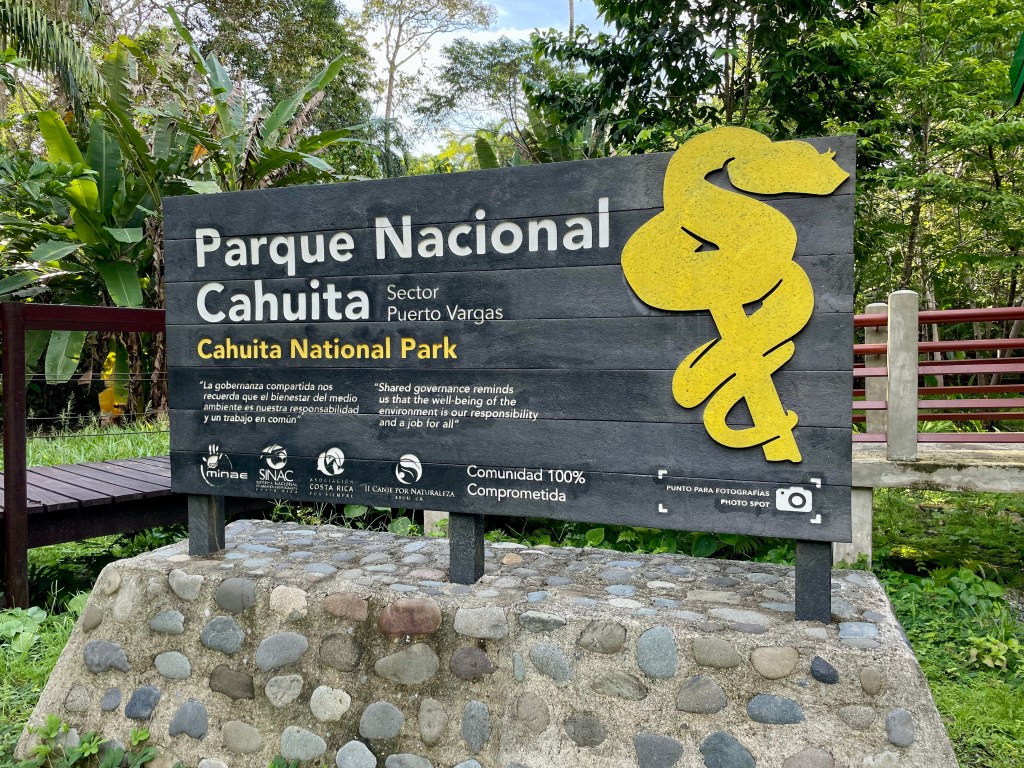
Who got a spot in our ranking of Top 5 Animals in Costa Rica
5. Beautiful, but deadly
One more colorful than the other, but keep your distance! We have discovered Poison Dart Frogs in multiple locations throughout the country – from Pacific to Caribbean. We kinda became obsessed with these diurnal amphibians as their skin’s characteristics are colourful shapes. But, wait aren’t frogs nocturnal? Those that you hear and see – such as the Red Eyed Tree Frog – only at night, are mostly not dangerous and carry none or only small amounts of poison. Herein lies also the reason for the fact that these frogs are poisonous. During the day, they could be attacked by many predators. Therefore, the colorful skin is a warning to them. Poison Dart Frogs of Costa Rica even have the ability of lethal impact on a human body. In very small amounts, indigenous tribes use the intoxicating effects of the poison.
We have spotted two types of Poison Dart Frogs in Costa Rica: The Green-Black Poison Dart Frog and the Strawberry Poison Dart Frog (they like it, where cacao plants are).
Where to see Dart Frogs in Costa Rica in the wild?
They are not always easy to spot, as Dart Frogs are only about 1-2 cm. So, keep your eyes open, when you visit these places:
- Green-Black Poison Arrow Frog in Parque Nacional Carara, Tarcoles
- Strawberry Dart Frog in CARIBBEANS Cacao Tour, Puerto Viejo
ONLY VIEW FROM DISTANCE!
4. Sometimes shy, sometimes bold
It took us two trips to Costa Rica to spot all four species of the animal in 4th position of our Top 5 Animals in Costa Rica: Monkeys. Does four types mean four times the chance of seeing primates? Some are more visible than others. The white-faced monkey, also known as Capuchin, counts as the most popular of its kind. It is sometimes not cautious at all when it comes to contact with humans (take care of your belongings at the beach in Parque Nacional Manuel Antonio). Geoffrey’s Spider Monkey live in more remote places that allow for large group sizes. The Central American Squirrel Monkey is the rarest and smallest of the four. You might identify it by it’s remarkable squeaking sound. On the other side, the – pretty loud – Mantled Howler Monkey can be seen from Guanacaste to the south of Puntarenas to the Caribbean coast. Read more about each species in our Costa Rica Wildlife blog.
Where to see monkeys in Costa Rica in the wild?
Monkeys can be seen all over the country, in nearly every forestated National Park. We are recommending the places, where we saw each species most frequently and with our own eyes:
- White Face Monkey in Parque Nacional Manuel Antonio
- Mantled Howler Monkey in Parque Nacional Manuel Antonio, Osa Peninsula
- Geoffrey’s Spider Monkey in Parque Nacional Tortuguero, La Fortuna
- Central American Squirrel Monkey in Parque Nacional Corcovado
Advise: The only place where you can see all four monkeys in one place is Parque Nacional Corcovado.
3. Two can play this game!
Costa Rica is home to six species of this colorful animal: Toucans. There was no way passing these birds in our Top 5 Animals in Costa Rica. You can find: Emerald Toucanets, Yellow-Eared Toucanets, Fiery-Billed Aracaris, Collared Aracaris, Black Mandibled Toucans, Keel-Billed Toucans. One is more beautiful than the otters! But, to be fair, as some species are very hard to find, we were not successful seeing all of them in the wild so far. We tried our best and were sometimes surprised by their unique style of flying or “hopping” like rabbits from branch to branch. Watch them and you will be amazed!
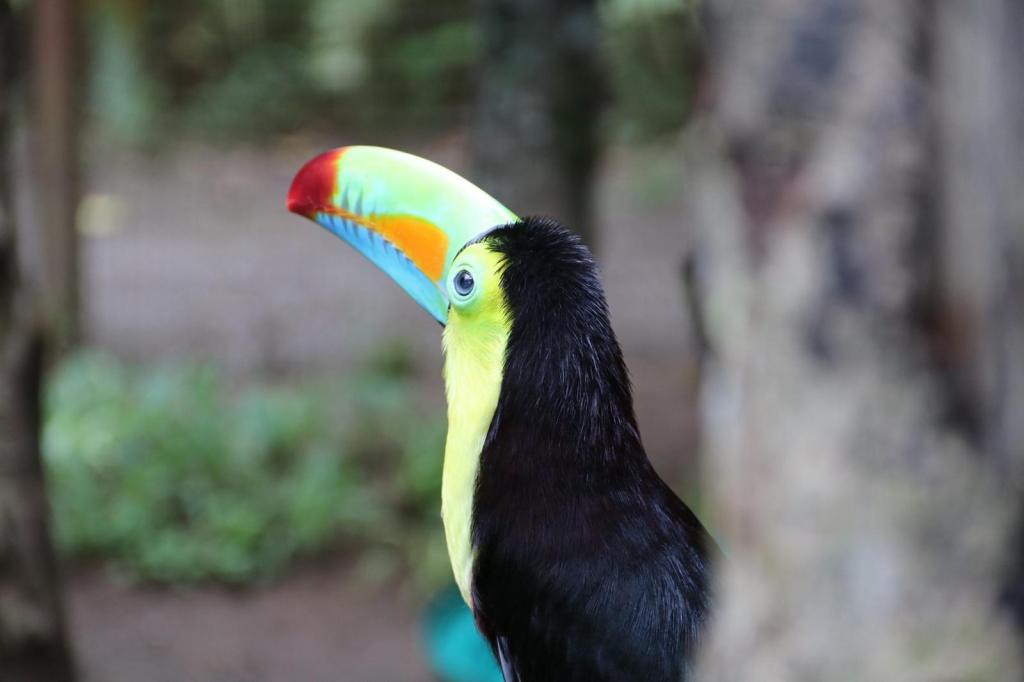
Where to see Toucans in Costa Rica in the wild?
- Collared Aracari in Puerto Viejo
- Black Mandibled Toucan in Quepos
- Keel-Billed Toucan in Sendero Bogarín, La Fortuna or Playa Jacó, Jacó
Learn more about Toucans here
2. Colorful king of the air
An unmistakable deep squawk, a majestic flight position and rainbow-like plumage in the sky: you are most likely in presence of a beautiful Scarlet Macaw. The colorful kings of the air are in second position to the throne of our Top 5 Animals in Costa Rica. Apart from this species, you can also find the Great Green Macaw here, that is rarely in sight as critically endangered (luckily, conservationists like Ara Manzanillo work on stabilising the populations). A trip to Costa Rica should never end before admiring a macaw (more here)!
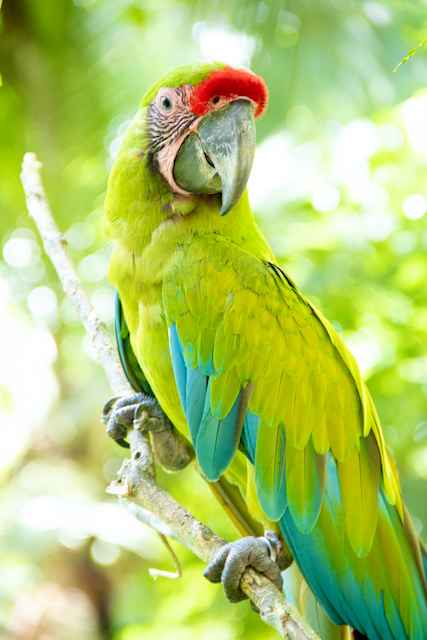
Where to see macaws in Costa Rica in the wild?
Just a couple of decades ago, this was an unnecessary question. Macaws used to call 85% of Costa Rica’s land its habitat. Due to deforestation and human interference, it’s not a matter of course to see macaws in Costa Rica in the wild. Luckily, there are still places, where you can enjoy watching them in the wild. Stay close to the shore and beach!
- Bahia Drake, Osa Peninsula, Puntarenas
- Punta Quepos/Playa Espadilla Norte, Quepos, Puntarenas
- Playa Hermosa, Jacó, Puntarenas
- Isla de Tortuguero, Límon
- Playa Manzanillo, Manzanillo, Límon
Our advise to see macaws in Costa Rica: You have the biggest chance to spot them in the morning and afternoon – keep an eye on almonds dropping on the ground.
1. If ‘pura vida’ was an animal
Peaceful, laidback and always with a friendly smile on the face: This animal had to be our number one. Nothing reflects ‘Pura Vida’ (ref. = The Costa Rican way of living) better, than a sloth! Costa Rica is a sloth haven, you can find both types of sloth here.
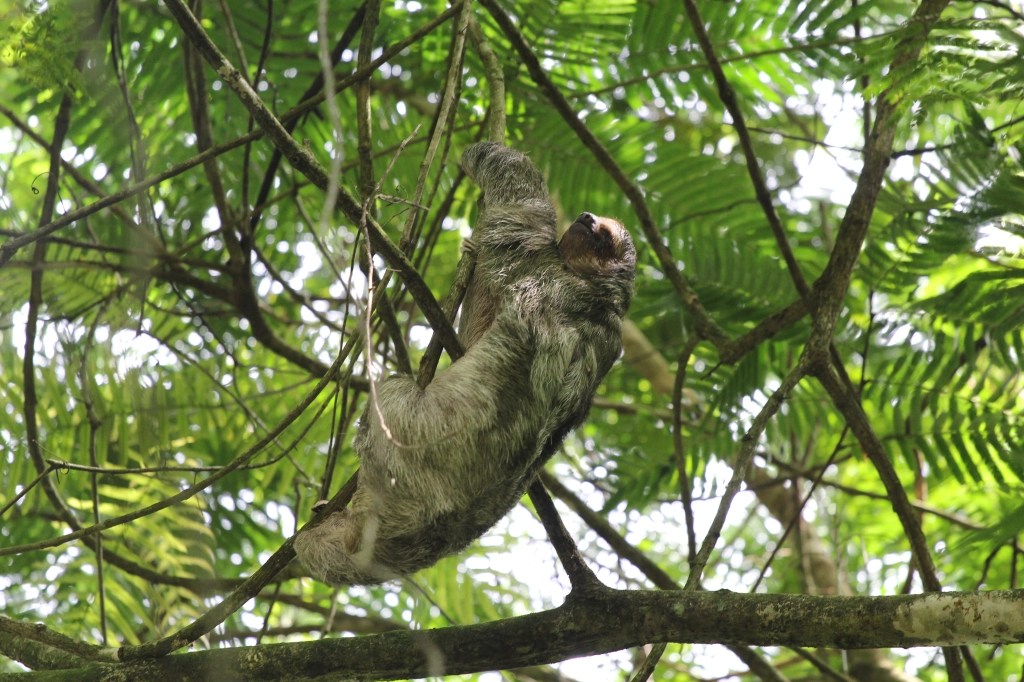
Did you know that the two types of sloth are not as closely related as many think? The leaders in our Top 5 Animals in Costa Rica are both lazy, sleep 20 h/day, climb down the trees only to poop and feed primarily on leaves. They are also the slowest mammal in the world and are so sedentary that green algae develops on its fur. Apart from that, they don’t have much in common. Just take a look at their biological features.
| Traits | Hoffmann’s Two-toed sloth | Brown-Throated Three-toed sloth |
|---|---|---|
| Head mobility | 6 vertebrae – can turn its head only 90degrees | 9 vertebrae – can turn its head 270 degrees |
| Tails | Doesn’t have a tail and has similarly sized arms and legs | Has a small tail and much longer front legs than the rear ones |
| Face | Shorter neck and larger eyes | It has distinct mask-like black markings around its eyes |
One thing said… whenever we discover a sloth in the Costa Rican jungle, we get excited as if it was the first time!
Where to see sloths in Costa Rica in the wild?
We have good and bad news, when it comes to our recommendations for where to see sloths in Costa Rica. Good news first: You can see sloths almost all over Costa Rica. Now the bad news: be prepared to get a stiff neck and a lot of stamina searching for them. One needs an eagle eye to spot the furry friends, because due to the hot climate they spent most of their day in the canopy. We recommend these places to see sloths in Costa Rica:
- Parque Nacional Cahuita, Cahuita
- Bogarín Trail, La Fortuna
- Parque Nacional Manuel Antonio, Manuel Antonio
We were not able to see sloths in Parque Nacional Tortuguero or Parque Nacional Corcovado, but apparently these are also great locations.
 Two Shoulder Straps